Last Updated: November 15, 2026
Quick Summary
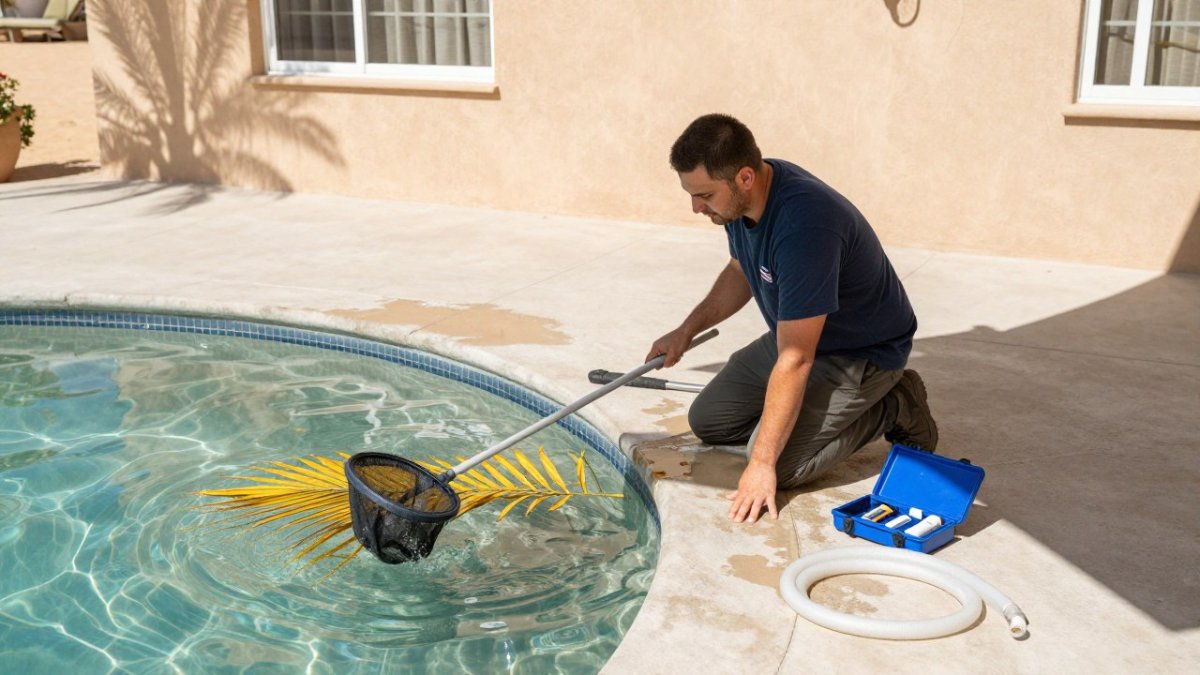
Most Arizona pools should stay open through winter with reduced maintenance rather than closing. Cut pump run time as water cools, test chemistry every one to two weeks, clean debris on a set schedule, and protect equipment from freezing on cold nights. A pool for Arizona winter stays easier to manage when it keeps running.
- Most Arizona homeowners should keep the pool running but scale back the work.
- Drop pump run time to about 2 to 3 hours a day when water falls below 50°F.
- Test free chlorine, pH, alkalinity, calcium and cyanuric acid every one to two weeks.
- Run the pump through the coldest hours whenever the forecast low is near 34°F.
- Avoid shutting the pump off for weeks, since stagnant water turns green by spring.
Table of Contents
- Keep Your Pool Open or Close It for Arizona Winter
- Build a Winter Pump Schedule Based on Water Temperature
- Test and Balance Pool Chemical Levels in Winter
- Clean the Pool, Filters, and Baskets on a Winter Schedule
- Protect Pool Equipment From Freezing by Region and Elevation
- Winter Supplies Checklist and Maintenance Calendar
- Book Your Winter Pool Maintenance Visit
- Frequently Asked Questions
Keep Your Pool Open or Close It for Arizona Winter
Most Arizona pools stay open through winter, and a pool for Arizona winter rarely needs to close because the water seldom gets cold enough to justify it.
The real question is how much to reduce the work while keeping the water safe.
Most homeowners should keep the pool running but scale back:
- Run the pump less often as the water cools
- Test the water every one to two weeks
- Clean debris and baskets on a set schedule
- Check equipment for freeze risk on cold nights
Winter in the Phoenix area is short, but nighttime lows can drop near freezing. That is the main risk to plan around, and it is covered later in this guide.
Build a Winter Pump Schedule Based on Water Temperature
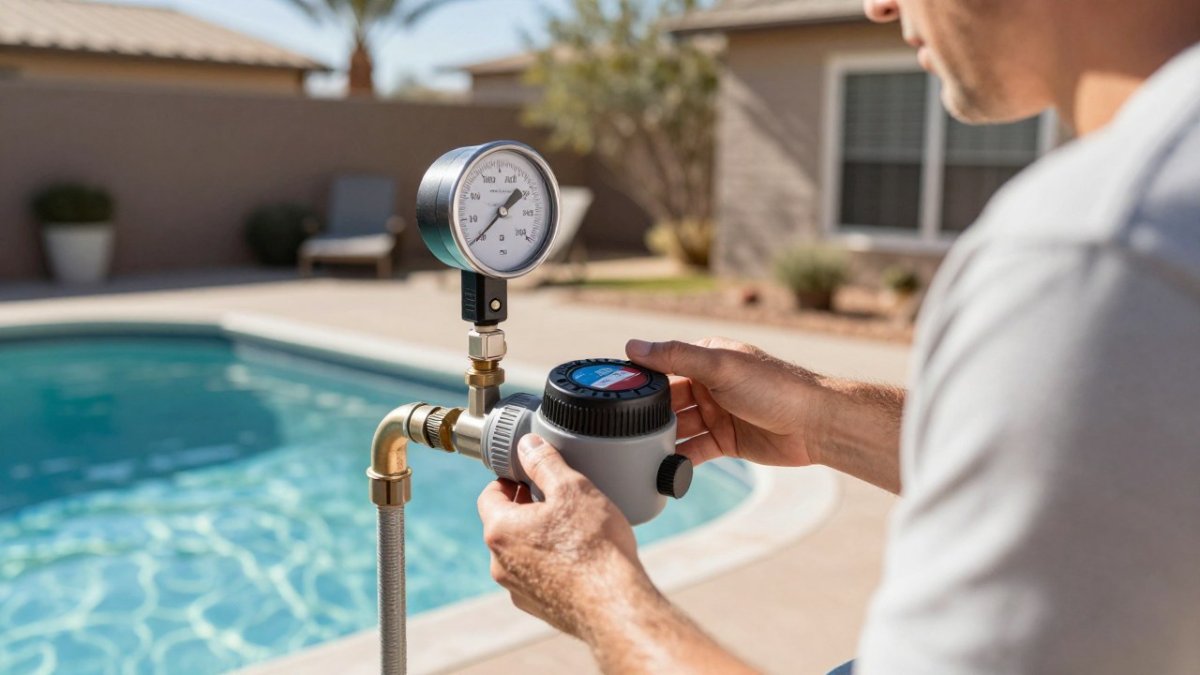
Pump time in winter is a turnover problem, not a habit. The goal is to move the pool's full volume through the filter often enough to keep water clear and chlorine distributed, and that need drops as water temperature drops.
Start with the temperature bands, then adjust:
| Water temperature | Typical run time | Notes |
|---|---|---|
| Above 70°F | About 8 hours a day | Close to summer schedule; keep an eye on chlorine demand |
| 60°F to 70°F | About 6 hours a day | Good time to shift run time to the warmest part of the day |
| 50°F to 60°F | About 4 hours a day | Split into two runs if your pool collects leaves |
| Below 50°F | About 2 to 3 hours a day | Split into one or two runs; never shut off for weeks |
Adjust for equipment and pool type:
- Single-speed pumps: Run the hours above in one or two blocks. A single-speed pump uses the same power per hour regardless of flow, so shorter, well-timed runs save more than long, low-value runs.
- Variable-speed pumps: You can often run longer at lower speed for less energy than a short high-speed run. A common pattern is to run at a low speed for most of the day and bump to a higher speed for a short window to skim the surface and clear the skimmer.
- Automation and freeze protection: Confirm the schedule is stored in the controller and that freeze protection overrides the schedule when air temperature drops near freezing. Test the override before the first cold night.
- Saltwater pools: The chlorine generator only produces while the pump runs, so do not cut run time so far that the cell cannot keep up. If the cell struggles in cold water, supplement with liquid chlorine rather than extending pump hours just to feed the cell.
Why the hours drop: colder water holds chlorine longer and algae grow more slowly, so the filter has less to remove and the sanitizer less to fight.
Set the schedule by trigger, not by date:
- When the water first drops below 70°F, cut summer run time roughly in half.
- When it drops below 60°F, move to about 4 hours and shift the run to midday.
- When it drops below 50°F, move to 2 to 3 hours and split the run.
- When water warms back above 60°F in late winter, step back up one band at a time.
Watch out: Do not shut the pump off for weeks at a time in cold water.
Test and Balance Pool Chemical Levels in Winter
Winter water chemistry needs attention, but demands are lower than in summer.
Test the water every one to two weeks. Check these readings:
| Test | Target Range | Why It Matters |
|---|---|---|
| Free chlorine | 1.0 to 3.0 ppm | Keeps algae and bacteria in check |
| pH | 7.2 to 7.6 | Protects swimmers and equipment |
| Total alkalinity | 80 to 120 ppm | Keeps pH steady |
| Calcium hardness | 200 to 400 ppm | Prevents scaling and surface damage |
| Cyanuric acid | 30 to 50 ppm | Protects chlorine from sun loss |
Chlorine demand drops in cold water, so you will often need less than in summer.
Saltwater pools need the same testing, plus a check on the salt level.
Most winter problems start with chemistry that drifts for weeks untested. Learn how to keep your pool water crystal clear through the winter.
Clean the Pool, Filters, and Baskets on a Winter Schedule
Winter cleaning is lighter than summer cleaning, but it still matters.
A common mistake is waiting until the water looks dirty; by then debris has already begun to break down.
A simple winter cleaning routine:
- Empty the skimmer basket every few days or after storms
- Empty the pump basket weekly
- Brush the walls and floor every one to two weeks
- Vacuum settled debris as needed
- Backwash or rinse the filter when pressure rises about 8 to 10 psi above its clean level
Check the pump basket first when the pump struggles or flow drops; a clogged basket makes the pump work harder and waste energy.
Absolute Blue Pool offers weekly pool maintenance for Phoenix-area homes.
Protect Pool Equipment From Freezing by Region and Elevation
Freeze risk in Arizona is not one problem but a set of problems that change with elevation and equipment-pad exposure. Plan around your elevation band, not a single statewide rule.
Lower desert (roughly below 2,500 feet, including the Phoenix and Tucson metro areas):
- Hard freezes are uncommon, but nighttime lows in the low 30s happen in December and January, especially in outlying areas and open lots where cold air settles.
- The main defense is moving water. Run the pump through the coldest hours whenever the forecast low is at or below about 34°F.
- Insulate exposed above-ground plumbing with foam pipe covers, and wrap backflow preventers, pressure-side lines, and exposed valve bodies.
- Keep the equipment pad clear of shade cloth and debris so daytime sun can warm the plumbing.
- If your pump or automation has freeze protection, confirm it is enabled and the air-temperature sensor reads correctly before the first cold night.
Mid-elevation (roughly 2,500 to 4,500 feet, including parts of the high desert and foothill communities):
- Expect several nights below freezing each winter and occasional multi-day cold snaps.
- Run the pump all night during any forecast freeze, and consider running it continuously through a multi-night event.
- Drain and blow out exposed irrigation or pool-fill lines that are not in use.
- Protect the heater per the manufacturer's freeze guidance, or isolate and drain it if it will not run.
Higher elevation (roughly above 4,500 feet, including the high country and mountain communities):
- Sustained freezes are normal, and equipment left full of water can crack.
- If the pool will not be used, full winterization with lines blown out and equipment drained is safer; if it stays open, plan on continuous pump operation during freeze events and a backup plan for power loss.
- Keep a spare pump basket, union O-rings, and foam insulation on hand, because a cracked fitting in a remote area can mean days without service.
Before a freeze warning, work this checklist:
- Confirm the forecast low and expected duration below freezing; a two-hour dip differs from a 12-hour freeze.
- Turn the pump on and set it to run through the coldest hours, typically overnight into early morning.
- Verify the water level is at the middle of the skimmer so the pump does not pull air and lose prime.
- Wrap exposed lines, valves, and the filter housing with foam covers or moving blankets; do not seal the equipment in a way that traps moisture.
- Turn off the heater if the manufacturer recommends it for freezing conditions, and note whether the unit has a freeze-protection mode requiring power and water flow.
- Photograph the equipment pad as a baseline if something cracks.
After a freeze, recover in order:
- Look for ice on the pad and lines before touching anything.
- Check for cracked fittings, split unions, and leaks at valve housings.
- Restart the pump slowly and watch the pressure gauge; a sudden pressure drop or a pump that will not prime can signal a suction-side air leak or cracked line.
- Retest water chemistry once temperatures rise, since freeze events often bring heavy debris and a chlorine dip.
- If you find a cracked line, damaged heater, or a pump that will not prime, stop and call a licensed technician before running the system at full power.
Watch out: Do not assume a built-in freeze-protection feature will save the equipment during a power outage.
Winter Supplies Checklist and Maintenance Calendar
Keep these supplies on hand before winter starts:
- Pool test kit or test strips
- pH increaser and decreaser
- Liquid chlorine or chlorine tablets
- Calcium hardness increaser
- Skimmer net and pump basket cleaner
Use this calendar as a starting point:
| Timing | Task |
|---|---|
| Early November | Set the pump schedule and test all chemistry |
| Every 1 to 2 weeks | Test water and adjust chemistry |
| Weekly | Empty pump basket and brush surfaces |
| Every few days | Skim debris and empty skimmer basket |
| After storms | Clean debris and check the water |
| Before a forecast freeze | Run the pump and protect exposed lines |
| Late February | Increase pump hours as temperatures rise |
Pool-specific needs vary. Pools with covers, heaters, or variable-speed pumps may need different settings, so adjust the schedule to your equipment.
Book Your Winter Pool Maintenance Visit
Winter care is easier when someone checks the pool on a regular schedule. Absolute Blue Pool offers weekly maintenance and chemical balancing for Phoenix-area homes. Our pricing is flat-rate, and we do not require a long-term contract.
If you want a clear estimate for winter care, you can request a custom pool care quote and we will recommend the service level that fits your pool. Before you book, you may want to read our service terms to see how scheduling, pricing, and workmanship documentation work.
To see the full range of options, including weekly chemical balancing, full cleanings, and equipment inspections, browse our professional pool services.
Start with a free quote and a clear plan for the season ahead.
Frequently Asked Questions
Do I need to put chemicals in my pool during the winter?
Yes, but in smaller amounts. Cooler water and lower sun exposure mean chlorine is used more slowly, so the dose needed each week drops. Keep free chlorine, pH, alkalinity, and calcium hardness within the normal range even when the pool is used less. Test at least once a week, and adjust based on the readings rather than a fixed schedule. Water left unbalanced through a mild Arizona winter can still turn cloudy or develop algae, which is harder and more costly to fix in spring.
How many hours a day should I run my pool in the winter?
Most Arizona pools need far fewer hours than in summer. A common starting point is 4 to 6 hours a day when water temperatures are in the 60s, and 6 to 8 hours as temperatures climb. The goal is enough turnover to keep the water circulating and filtered, not a fixed number. Adjust the pump schedule as the weather changes, and run it during the warmest part of the day so the filter and chemicals work effectively.
Should I cover my pool during an Arizona winter?
A solar or safety cover helps hold heat, reduces debris, and cuts chemical loss from sun exposure. Keep the cover on when the pool is not in use, and remove standing water and debris from the cover before it goes on. Covers also add some freeze protection on cold nights, though they do not replace running the pump. Make sure the cover is secured so wind does not pull it loose.
What happens if I don't prepare my pool equipment for a freeze?
Water trapped in pump housings, filters, heater lines, and exposed plumbing can expand when it freezes and crack components. Running the pump during forecast freezes, insulating exposed lines, and draining or covering equipment where needed reduces the risk of costly repairs. Check equipment after any freeze before restarting it.
