Last Updated: November 4, 2026
Quick Summary
To skim a swimming pool, angle the net at roughly 45 degrees with the lip just under the surface and use a slow, steady drag, working into the wind so the breeze corrals debris toward you. Empty the skimmer basket first, since poor flow keeps debris on the surface.
- Skim daily during summer heavy use and after every storm during monsoon season.
- A flat skimmer net handles routine cleaning, while a deep leaf net suits heavy leaf loads.
- Fast strokes create a bow wave that pushes debris away from the net.
- Skim the surface first, then brush walls downward, then skim again to catch what floated free.
- Rinse nets and brushes after each use and store them out of direct sun to prevent brittle mesh.
Table of Contents
- Why Skimming Is the First Line of Pool Defense
- Tools You Need Before You Skim a Swimming Pool
- How to Use a Pool Skimmer Net the Right Way
- How Often to Skim a Pool Through Every Season
- How to Brush and Skim a Swimming Pool in One Pass
- How to Skim a Pool Without a Net
- Troubleshooting Debris That Sinks or Slips Past the Net
- Get a Free Quote for Weekly Skimming and Full Pool Care
- Frequently Asked Questions
Why Skimming Is the First Line of Pool Defense
Skimming a swimming pool is the practice of removing leaves, insects, pollen, and other floating debris from the water surface with a net before that debris has a chance to sink and decay.
Pools that get skimmed several times a week stay clear through the worst heat. Pools that get skimmed once a week turn cloudy by August.
Here is the part most guides skip: skimming is not really about looks. According to the Centers for Disease Control and Prevention guidance on healthy swimming, keeping debris and contaminants out of pool water is a core part of safe water management, not just a cosmetic chore.
Skimming is step one of a chain: skim, brush, vacuum, balance, filter. Skip it and the rest of the chain works harder for worse results.
Tools You Need Before You Skim a Swimming Pool
The right skimming kit is small and cheap. You do not need a shed full of equipment to keep a pool surface clean.
Here is what every pool owner typically keeps on hand:
- Flat skimmer net: wide mouth, fine mesh, for leaves, bugs, and pollen
- Deep leaf net: a bag-style net for heavy leaf loads and spring cleanup
- Telescopic pole: aluminum or fiberglass, long enough to reach the far wall from the deck
- Pool brush: for walls, tile line, and steps
- Skimmer basket: the basket inside the skimmer well, checked and emptied each visit
A common mistake is buying one net and expecting it to do everything. A flat skimmer net is the workhorse for routine cleaning; a deep leaf net is what you want after a storm or when trees are dropping.
Watch out: cheap telescopic poles bend at the locking collar under load.
How to Use a Pool Skimmer Net the Right Way
Using a pool skimmer net well comes down to three things: the angle of the net, the speed of your stroke, and the direction you work around the pool. Get those right and you will cut your skimming time roughly in half, especially if you work a repeatable route instead of re-skimming water you already cleared.
The mechanics
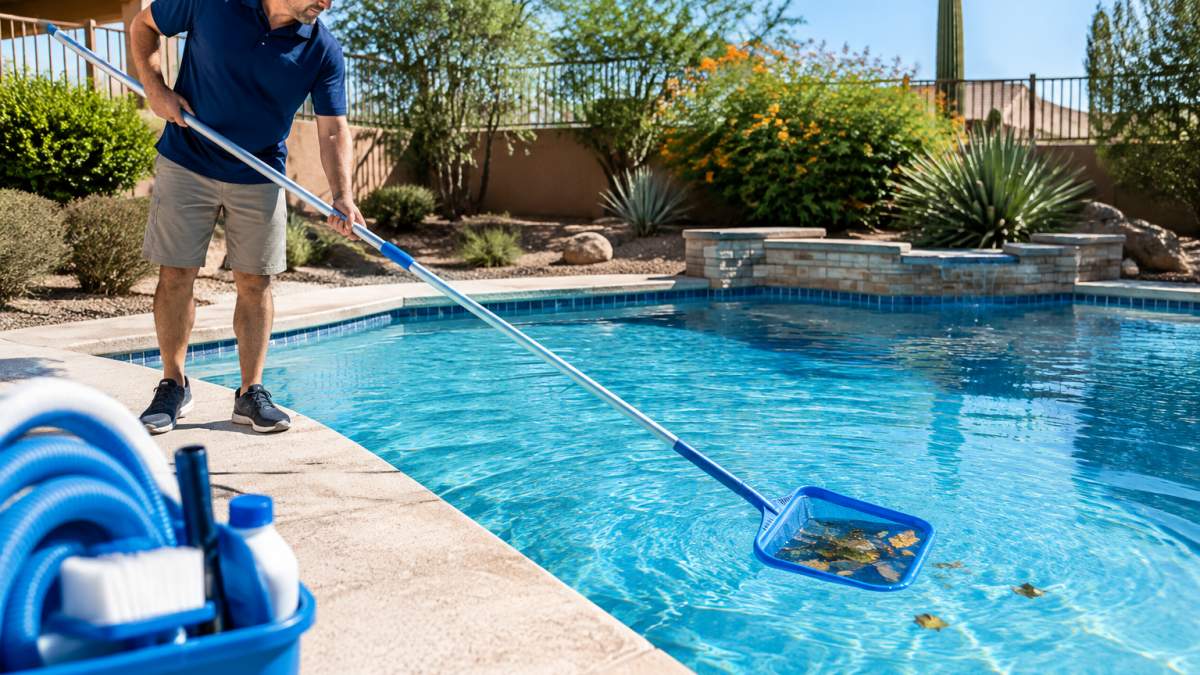
- Empty the skimmer basket first. A full basket means poor flow, and poor flow means debris stays on the surface instead of being pulled into the well.
- Work into the wind. Skim the side the wind is pushing debris toward, so the breeze corrals leaves for you.
- Angle the net at roughly 45 degrees. The lip should dip just under the surface, not float flat on top. A flat net skims almost nothing; an angled net traps debris on the mesh and holds it while you lift.
- Use a slow, steady drag. Fast strokes create a bow wave that pushes debris away from the net.
- Cast and skim. Flick the net outward, let it settle for a beat, then pull toward you in one smooth motion.
- Tap the net into your bucket instead of flipping it over the deck, which drops leaves and dirty water back into the pool.
The route by pool shape
- Rectangular pool: Start at the upwind short wall and work the long wall in lanes, pulling the net toward you in overlapping strips about as wide as the net mouth. Do the perimeter first, then the middle, finishing at the skimmer so the last pass pushes surface debris toward the weir.
- L-shaped or freeform pool: Treat each leg or lobe as its own rectangle. Skim the inside corners first, where debris stacks up, then work outward along each wall. Short, controlled pulls around the curve beat one long drag that misses the corner.
- Pool with steps, benches, or a tanning ledge: Skim the flat surfaces last, so debris you knock loose does not drift back over water you already cleared. Angle the net shallower over steps so the lip does not scrape the plaster.
- Large pool or one with a wide open middle: Work the perimeter, then cast toward the center and pull back to the edge in a fan pattern. Skim in two passes: a fast pass for big leaves, then a slower pass with a finer net for the small stuff.
Corners, ladders, and tight spots
Debris collects in corners, around ladder rails, and behind the skimmer weir. Turn the net edge-on to slide it into a corner, then rotate it flat to trap what is there.
Watch out: jabbing the net frame into the pool wall or tile line to reach a stubborn leaf chips plaster and grout.
Cast-and-skim versus dragging
Cast-and-skim is faster on open water and lighter debris because the net travels through undisturbed water.
How Often to Skim a Pool Through Every Season
How often you skim a pool depends on the season, the weather, and what surrounds the pool. No single number fits every yard.
A practical schedule for pool owners looks like this:
| Season or Condition | Skimming Frequency | Main Debris |
|---|---|---|
| Summer, heavy use | Daily or every other day | Sunscreen film, hair, insects |
| Summer, light use | 2-3 times per week | Insects, pollen, grass clippings |
| Monsoon season | After every storm | Leaves, dirt, branches |
| Fall | Daily during leaf drop | Leaves, seed pods |
| Winter, covered pool | Weekly check | Dust, stray leaves |
| Pool near trees | Daily | Leaves, flowers, twigs |
| Screened enclosure | 1-2 times per week | Fine dust, small insects |
If your pool sits under mesquite, palm, or ficus trees, treat daily as the baseline during dropping season. A single windy afternoon can undo a week of good skimming.
For pools inside a screened enclosure or under a cover, the debris load is much lighter. If that describes your setup and you would rather not handle the net yourself, our express pool service is built around weekly surface skimming and basket emptying for exactly those pools.
How to Brush and Skim a Swimming Pool in One Pass
Brushing and skimming together saves time and produces cleaner water than doing either alone.
Here is the combined routine:
- Skim the surface first, top to bottom of the pool, so floating debris does not stick to the walls as you brush.
- Brush the walls from the tile line downward, working in overlapping vertical strips.
- Brush the steps and any benches, then the corners where walls meet the floor.
- Brush the floor toward the main drain in long, overlapping passes.
- Skim the surface again to catch what the brush loosened and floated free.
- Empty the skimmer basket and rinse the net.
Why brush downward? Debris knocked off the wall falls toward the floor and drain instead of clouding the water you just cleaned.
Match the brush to the surface
- Plaster and concrete: a standard nylon-bristle brush is the workhorse. Stiff bristles are fine on plaster but will dull a vinyl liner.
- Vinyl liner: use a soft nylon brush only. Stiff bristles and wire brushes scratch the liner and can open pinholes.
- Fiberglass: soft or medium nylon, and keep the brush moving; sitting in one spot can dull the gel coat.
- Tile line: a dedicated tile brush or a hand-held brush gets the waterline film without dragging a full-width brush across the coping.
Pole handling and protecting the finish
Extend the pole only as far as you need and lock each collar firmly before you put load on it.
Rinsing and storing the net and brush
If you are coming from skimming only, expect the first few brush-and-skim sessions to look worse before they look better.
How to Skim a Pool Without a Net
You can skim a pool without a net, but only in a few specific situations. A net is still the right tool for routine cleaning.
The realistic options are:
- Let the skimmer do the work. The built-in skimmer pulls surface debris into its basket as water circulates. Run the pump long enough and it handles light loads.
- Use a robot cleaner. Robotic cleaners handle floor and wall debris well, and some surface models exist, but they are not a substitute for a quick net pass.
- Use a leaf rake or a pool brush to corral debris toward the skimmer.
- Use a shop vac for small, contained spills, never for routine cleaning.
Watch out: turning off the pump to "let things settle" is the opposite of what you want. Circulation is what moves surface debris into the skimmer.
The honest answer is that nothing replaces a net for floating debris.
Troubleshooting Debris That Sinks or Slips Past the Net
Fine debris, pollen, and anything that has already sunk will not come up with a skimmer net. That is a filtration and circulation problem, not a netting problem.
Common culprits and what to do about them:
- Pollen and fine dust: use a finer mesh net, and check that the filter is clean
- Debris slipping past the net: slow your stroke and angle the net deeper
- Sunken leaves on the floor: vacuum, do not net
- Debris returning through the returns: check the filter and the pump basket
- Persistent surface film: usually oils and sunscreen, which need chemistry, not netting
A common mistake is chasing sunken debris with a net for twenty minutes. Our one-time pool cleanups cover full cleanings, equipment checks, and green pool recovery.
For the chemistry and circulation side of the picture, our guide on how to maintain crystal clear pool water walks through filtration, water balance, and weekly routines in detail.
Get a Free Quote for Weekly Skimming and Full Pool Care
Skimming decides how the rest of your pool care goes. When it slips, everything else costs more: more chemicals, more filter cleaning, more recovery work after a storm.
If you would rather hand the net to someone else, we offer full-service pool cleaning that covers vacuuming, brushing, skimming, basket emptying, equipment checks, and complete chemical balancing on a consistent weekly schedule.
You can get a free quote for weekly pool care.
Frequently Asked Questions
What's the best way to skim a pool?
Work with the wind and the pool's circulation, not against them. Stand at the downwind side and use the cast-and-skim method: toss the net out, let it settle, then draw it back toward you in a slow, steady glide. Empty the skimmer basket into a bucket before it fills, and skim the surface before brushing so floating debris doesn't get pushed back into the water.
How often should you skim a swimming pool?
Aim for once a day during heavy leaf drop, monsoon season, or when trees and flowers surround the pool. In quieter periods, two to three times a week keeps the surface clear. After a storm, skim immediately, because sunken leaves break down fast in warm water and add to the load on your filter and sanitizer.
Should you skim a pool before or after brushing it?
Skim first. Brushing loosens algae and dirt from the walls and floor, and some of that material floats up to the surface. If you brush before skimming, you give yourself a second round of debris to catch. Skim, brush, then skim again briefly if the water looks cloudy near the top.
Can you skim a pool without a net?
You can remove some surface debris with a leaf rake, a skimmer basket, or by running the filter and letting the skimmer do the work, but none of these replace a net for daily touch-ups. A flat skimmer net is inexpensive and reaches debris a basket cannot, so it is worth owning even if you rely on automation most days.
The challenge with skimming is not knowing what to do. It is doing it consistently through monsoon season, heat, and leaf drop, week after week, without letting the water chemistry drift. That consistency is what Absolute Blue Pool was built around: transparent flat-rate pricing, no lock-in contracts, consistent service days, and Arizona-specific water chemistry expertise. Get started with Absolute Blue Pool and keep your pool clear without adding another chore to your week.
