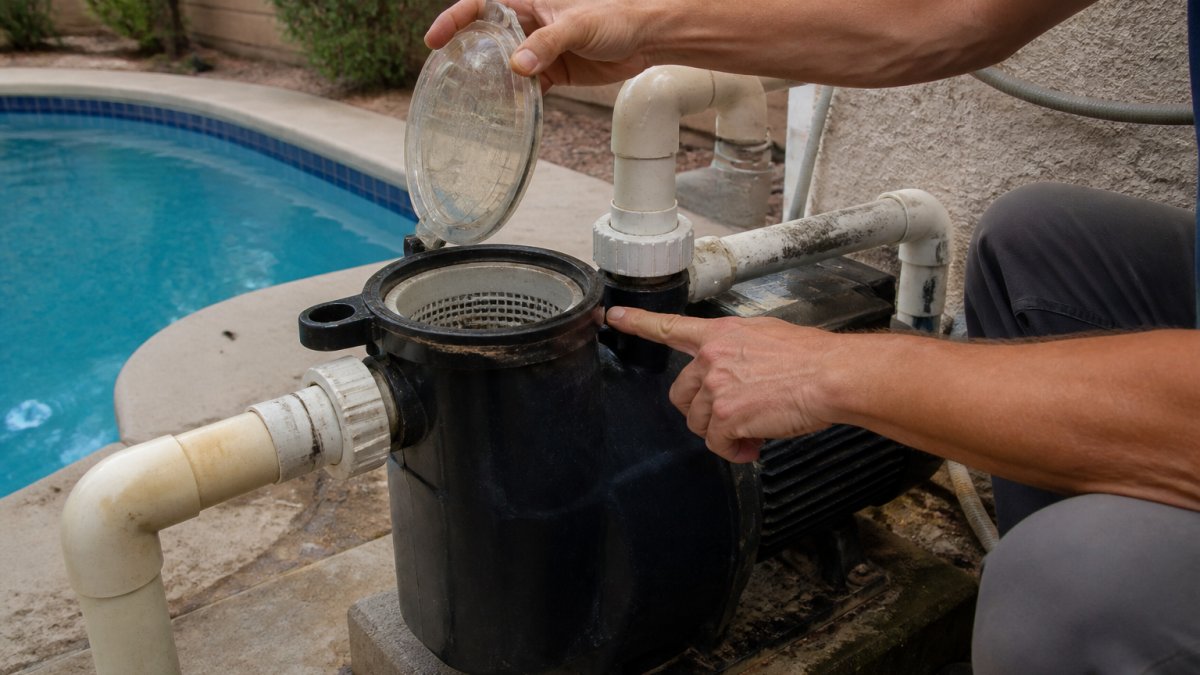
Last Updated: November 2, 2026
Quick Summary
A pool pump losing prime means air is entering the suction side, so check the water level, baskets, pump lid O-ring, drain plugs and unions in that order before testing for suction-side leaks. Most prime problems trace back to something simple near the water's surface, so confirm the cheap causes first. Never run a pump dry to see if it catches.
- Water level should sit at the middle of the skimmer opening, and the weir should float freely.
- A self-priming pump should recover prime within a minute or two of startup.
- Air leaks show bubbles and low filter pressure; water-side restrictions show high pressure and no bubbles.
- Backwash or clean the filter when pressure climbs 8 to 10 psi above the clean baseline.
- Kill power at the breaker before opening anything or reaching near the impeller.
Table of Contents
- Start With a Safe, Ordered Diagnostic Workflow
- Check Water Level and Skimmer Operation First
- Inspect the Skimmer, Pump Basket, and Strainer Housing
- Signs of a Pool Pump Air Leak and How to Confirm Them
- Pool Pump Lid O-Ring Replacement and Drain Plug Checks
- Find and Test Suction-Side Leaks Systematically
- Pool Pump Impeller Blockage and Water-Side Restrictions
- Book a Prime-Loss Inspection With Absolute Blue Pool
- Frequently Asked Questions
Start With a Safe, Ordered Diagnostic Workflow
A pool pump losing prime means air is getting into the system, and the fix starts with a fixed order of checks. Work from the water level inward to the pump, then test the suction side.
Here is an order that works:
- Water level and skimmer operation
- Baskets and strainer housing
- Pump lid and O-ring
- Drain plugs and unions
- Suction-side leak testing
- Impeller and water-side restrictions
Why the order matters: most prime problems trace back to something simple near the water's surface. Air entering at the skimmer looks identical to air entering at a cracked union.
Watch out: never run a pump dry to "see if it catches." A few minutes without water flow can overheat the motor and warp the seal. Kill power at the breaker before you open anything.
Work through the checks in this order so you confirm the cheap causes before opening any plumbing.
| Step | What to check |
|---|---|
| 1 | Water level and skimmer operation |
| 2 | Baskets and strainer housing |
| 3 | Pump lid and O-ring |
| 4 | Drain plugs and unions |
| 5 | Suction-side leak testing |
| 6 | Impeller and water-side restrictions |
Check Water Level and Skimmer Operation First
Low water is the most common reason a pool pump won't prime. If the water sits below the skimmer mouth, the pump pulls air instead of water.
Check these before touching the equipment:
- Water level should sit at the middle of the skimmer opening
- The skimmer weir should float freely and not stick
- The skimmer basket should be empty and seated flat
- No vortex or gurgling sound at the skimmer throat
A stuck weir acts like a closed door. Water can't flow in, so the pump starves. Lift it, clean the tracks, and confirm it swings.
If the level is low, add water and give the system ten minutes to settle. For the full routine, see our guide on how to maintain crystal clear pool water. Then restart the pump and watch the return jets. Steady flow with no bubbles means you found it.
Inspect the Skimmer, Pump Basket, and Strainer Housing
A clogged basket chokes water flow and mimics a prime failure. Debris starves the pump, the pot drains, and the motor runs hot.
Work through this checklist:
- Empty the skimmer basket and rinse it
- Pull the pump basket and clear leaves, hair, and pine needles
- Check the strainer basket for cracks or a warped rim
- Look inside the pump housing for debris stuck at the inlet
- Confirm the basket sits flush, not tilted
A tilted basket lets debris slip past and pack into the impeller. If you would rather hand off basket emptying and equipment checks, see our full-service pool cleaning. That turns a two-minute fix into a repair job.
Signs of a Pool Pump Air Leak and How to Confirm Them
Signs of a pool pump air leak include bubbles in the pump pot, bubbles from the return jets, a pump that loses prime overnight, and a filter pressure that reads low. Any one of these points to air on the suction side.
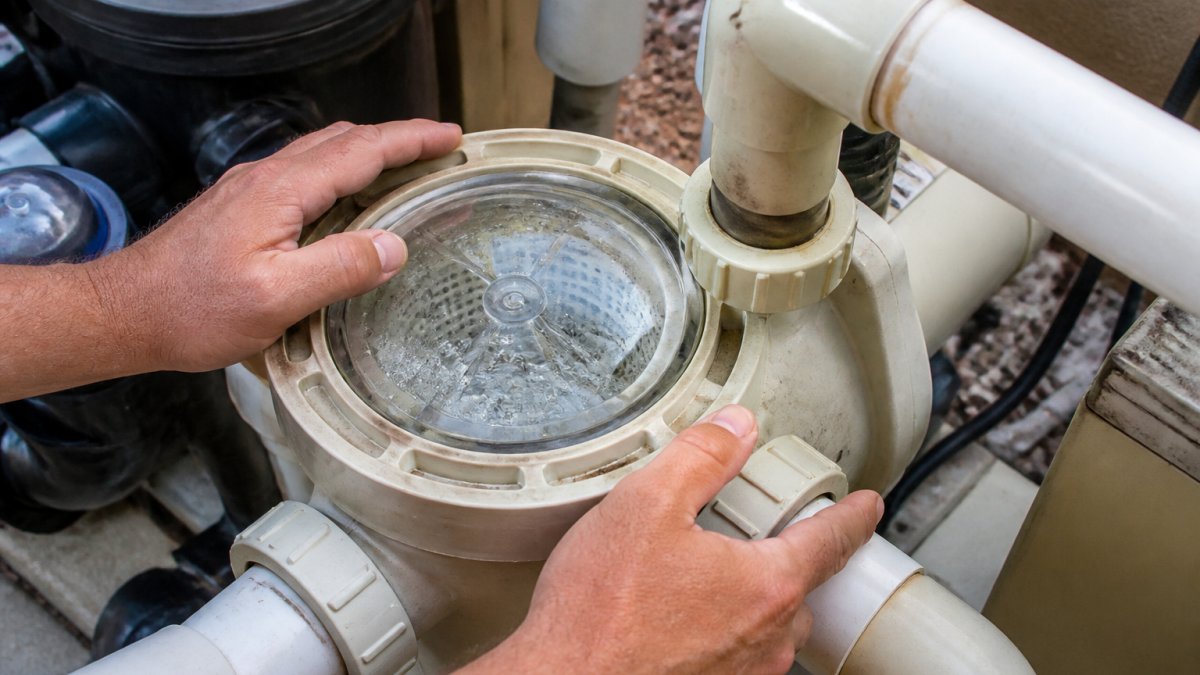
Confirm it in three steps:
- Watch the pump pot for 30 seconds after startup. A swirl of bubbles that never clears means air is entering.
- Shine a flashlight at the return jets. A steady stream of tiny bubbles confirms the same thing.
- Shut the pump off and listen. A gurgling sound near the equipment pad means the system is pulling air back through a bad seal.
One distinction matters here. Air leaks show bubbles and a pot that drains when the pump stops. Water-side restrictions show high filter pressure, weak flow, and no bubbles. Those are two different problems with two different fixes.
Pool Pump Lid O-Ring Replacement and Drain Plug Checks
Pool pump lid O-ring replacement fixes more prime problems than any other single part. A dry, cracked, or flattened O-ring lets air slip past the lid every time the pump runs.
Here is how we check and replace it:
- Shut off power at the breaker
- Remove the lid and lift out the O-ring
- Wipe the groove clean of grit and old lube
- Inspect for cracks, flat spots, or stretching
- Coat a new O-ring with silicone pool lube and seat it evenly
- Tighten the lid hand-tight only
Watch out: over-tightening the lid warps the O-ring and creates the leak you were trying to stop.
Next, check the drain plugs on the pump housing. Remove each plug, inspect the drain plug gasket, and replace any that look worn. Do the same for union O-rings at the pump inlet and outlet. A loose union fitting or a hardened union O-ring pulls air with no visible sign.
Find and Test Suction-Side Leaks Systematically
Testing suction-side leaks means isolating one section of plumbing at a time until the bubbles stop. Guessing wastes hours. Testing finds the leak in minutes.
Start with the pump off and the system settled. Dry every fitting on the intake line with a rag so you can see moisture later.
Use this sequence:
- Shut off the pump at the breaker and let the system sit for five minutes.
- Dry every fitting, valve, union, and plug on the suction line.
- Restart the pump and watch the pump pot for 30 seconds.
- If bubbles appear, shut down and wrap one suspect joint at a time in plastic wrap.
- Restart and watch the pot. If bubbles clear, you found the leak. Mark it and move to the next joint.
A shaving cream test works on the same principle. Smear a thin layer over a suspect joint with the pump running.
Valve position is a diagnostic tool, not just a setting.
Common leak points on the suction line, roughly in order of how often they show up:
- Pump lid O-ring and lid threads
- Union fittings at the pump inlet
- Drain plugs on the pump housing
- Valve stems and valve position handles
- Threaded plumbing connections
- Cracks in the pump housing
- Aging shaft seal
- Buried intake line fittings or a cracked equalizer line
A shaft seal leak usually shows water dripping under the pump, not bubbles in the pot.
Pool Pump Impeller Blockage and Water-Side Restrictions
Pool pump impeller blockage starves flow and can look like a prime problem from the filter gauge. If the pot stays full but flow stays weak, the restriction is downstream or at the impeller.
Use this comparison before you open anything:
- Air leak on the suction side: bubbles in the pump pot, bubbles from the return jets, low filter pressure, and a pot that drains when the pump stops.
- Water-side restriction: no bubbles, high filter pressure (often 8 to 10 psi above the clean-filter baseline), weak return flow, and a pot that stays full.
- Impeller blockage: pot stays full, filter pressure may read normal or low, return flow is weak, and the pump sounds normal or slightly louder.
Check these in order once you have ruled out air:
- Filter: a dirty cartridge or a sand filter that needs backwashing raises pressure and cuts flow. Note the clean baseline pressure after a fresh cleaning and backwash or replace media when pressure climbs 8 to 10 psi above that baseline.
- Impeller: power off at the breaker, remove the basket, and feel the impeller eye for debris. Clear it with a bent wire or soft brush. Hair, pine needles, and small toys are common culprits.
- Return jets: clogged eyeballs reduce circulation and make the pump work harder. Remove and rinse each eyeball, then confirm the flow at each return.
- Valves: a half-closed valve on the suction or return side chokes the whole system. Confirm every valve handle is fully open or fully closed as designed, not partway.
- Plumbing: a collapsed flex hose, a kinked line, or a partially closed check valve on the return side can restrict flow without showing bubbles.
A self-priming pump should recover prime within a minute or two of startup. If it hunts for prime and never settles, the problem is usually air on the suction side, not the impeller.
Watch out: never reach into the impeller or strainer housing with the pump connected to power. The motor can start on a timer or remote command even when the switch looks off.
When a pump has run dry, overheated, or lost prime repeatedly, repair may not be the answer.
Book a Prime-Loss Inspection With Absolute Blue Pool
Prime loss has a short list of causes, and a methodical check finds nearly all of them. Water level, baskets, lid O-ring, drain plugs, suction-side air, and impeller blockage cover the field. When the cause sits behind a sealed pump housing or a buried intake line, stop and bring in a pro.
That is where we come in. Absolute Blue Pool has served pool owners since 2004 with flat-rate pricing and no lock-in contracts. Our team focuses on Arizona pool chemistry and monsoon recovery, and we send proactive updates on your pool's health.
- Explore our pool inspection service to confirm and fix the prime loss
- Get your custom pool care quote for flat-rate weekly maintenance
- Get in touch with questions or to schedule a visit
Get started with Absolute Blue Pool and get your pump priming reliably again.
Frequently Asked Questions
Why does my pool pump lose prime when I turn it off?
A pump that loses prime after shutdown usually has a small air leak on the suction side that lets air slip in once the pump stops pulling. The most common culprits are a worn pump lid O-ring, a loose drain plug, a bad union O-ring, or a hairline crack in the pump housing. When the pump runs, suction can mask a tiny leak; when it stops, air enters and breaks the water seal, so the pump needs re-priming at the next startup. Inspect and reseal these fittings first.
How do I know if my pool pump lid O-ring is bad?
Look for a flattened, cracked, or stretched O-ring, or one that has turned hard and brittle. A thin film of water or a steady stream of bubbles around the pump lid while it runs is a strong sign. Clean the O-ring groove, apply a silicone-based pool lubricant, and reseat the lid. If the pump still pulls air, replace the O-ring. Keep a spare on hand because this is one of the most common causes of a pool pump losing prime.
Can a dirty filter cause a pool pump to lose prime?
Yes, a clogged filter or a blocked impeller restricts water flow and can cause the pump to struggle and lose prime, especially on startup or after vacuuming. Check the pump basket and skimmer basket first, then inspect the impeller for debris through the strainer housing. Backwash or clean the filter per the manufacturer's guidance. If pressure stays high after cleaning, the problem is likely on the water side, not an air leak.
How do I get rid of an airlock in a pool pump?
Turn off the pump, close the suction and return valves, and open the pump lid. Fill the pump pot with water until it reaches the top of the strainer basket, then reseat the lid and O-ring. Open the valves, and if your system has a bleed valve on the filter, open it to release trapped air. Start the pump and watch for steady flow at the return jets. Repeat the fill-and-start process if prime does not hold after two attempts.
Your pump should not be a weekly mystery. If prime loss keeps coming back, the cause is still in the system, and we can find it. Absolute Blue Pool offers flat-rate pricing, consistent service days, and no lock-in contracts, backed by two decades of Arizona pool experience. Get your free quote and let us take the equipment worry off your list.
