Last Updated: October 28, 2026
Quick Summary
Pool chemical balancing in Arizona heat means testing free chlorine, pH, alkalinity, calcium hardness and cyanuric acid more often than usual, because sunlight burns off chlorine and evaporation concentrates minerals. Aim for 2-4 ppm free chlorine and a pH of 7.2-7.6, and add chemicals in small steps during cooler hours.
- Free chlorine drops fast because UV light burns it off during the day.
- Check free chlorine daily during heat waves, with a target of 2-4 ppm.
- Wait at least 30 minutes with the pump running before retesting after adding chemicals.
- Keep cyanuric acid between 30 and 50 ppm, since high levels slow chlorine.
- Partially drain and refill when calcium hardness climbs above 400 ppm.
Table of Contents
- Why Arizona Heat Throws Off Pool Chemistry
- Pool Chemistry Levels Chart for Arizona Summers
- How Often to Test Pool Water in Extreme Heat
- Pool Chlorine Levels in Summer: Keeping Free Chlorine Stable
- Step-by-Step Pool Chemical Balancing Procedure
- Pool pH and Alkalinity Balance in Hot Weather
- Troubleshooting Cloudy or Green Water After a Heat Wave
- Start with a full test, not a guess
- Branch 1: Free chlorine is low but CYA is in range (30-50 ppm)
- Branch 2: Free chlorine is low and CYA is high (above 80 ppm)
- Branch 3: Calcium hardness is climbing (above 400 ppm)
- Branch 4: Chemistry looks fine but water stays cloudy
- Green water that will not clear
- When to call for service
- Booking a Summer Chemistry Check With Absolute Blue Pool
- Frequently Asked Questions
Why Arizona Heat Throws Off Pool Chemistry
Arizona summers are hard on pool water. Sunlight breaks down free chlorine, and the water evaporates, which concentrates everything left behind.
Absolute Blue Pool has operated since 2004.
Here is what usually shifts:
- Free chlorine drops fast because UV light burns it off during the day
- pH climbs as warm water releases carbon dioxide
- Water evaporates and leaves minerals behind, which raises calcium and total dissolved solids
- Bather load and monsoon storms add organics and dilution at unpredictable times
Pool Chemistry Levels Chart for Arizona Summers
Target ranges are a good starting point, but Arizona heat often means checking them more often. Use these as general guidance and confirm with a reliable test kit.
| Chemical | Typical Target | Summer Note |
|---|---|---|
| Free chlorine | 2-4 ppm | Check daily during heat waves |
| pH | 7.2-7.6 | Can drift upward through the afternoon |
| Total alkalinity | 80-120 ppm | Keeps pH from swinging |
| Calcium hardness | 200-400 ppm | Watch for scaling as water evaporates |
| Cyanuric acid (CYA) | 30-50 ppm | Stabilizes chlorine, but too much slows it |
Cyanuric acid protects chlorine from sunlight, but high levels can make chlorine work poorly (Effect of Cyanuric Acid on the Inactivation of Cryptosporidium parvum under...).
How Often to Test Pool Water in Extreme Heat
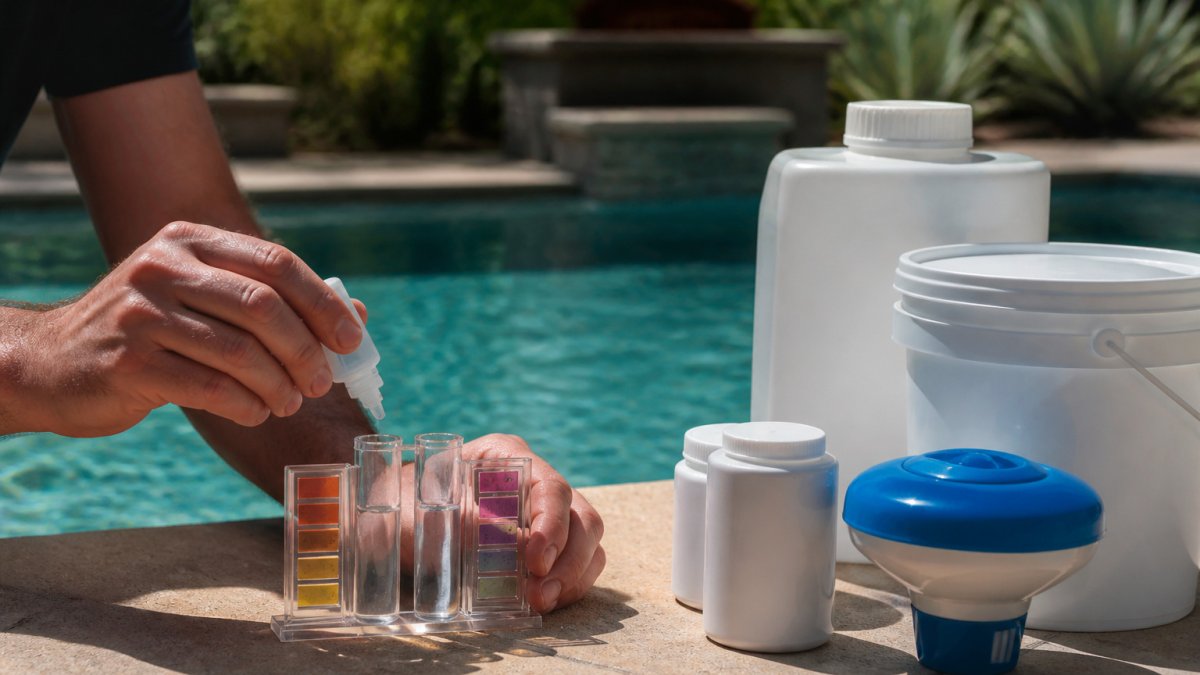
Digital testers and reliable test strips both work. Digital readers tend to be more consistent, but strips are fine for quick checks if you read them in good light. For a fuller routine covering filtration, circulation, and weekly habits, read the guide to keeping pool water crystal clear. A common mistake is testing right after adding chemicals. Wait at least 30 minutes, with the pump running, before you test again.
Pool Chlorine Levels in Summer: Keeping Free Chlorine Stable
Free chlorine is the working sanitizer (the CDC). In summer, it gets used up fastest, so it is the number one thing to watch.
Step-by-Step Pool Chemical Balancing Procedure
Run the pump during the coolest hours and avoid adding chemicals during the hottest part of the afternoon, when chlorine burns off fastest. If you would rather have a professional handle the balancing, you can book weekly chemical balancing directly.
Calculating Chemical Doses by Pool Volume
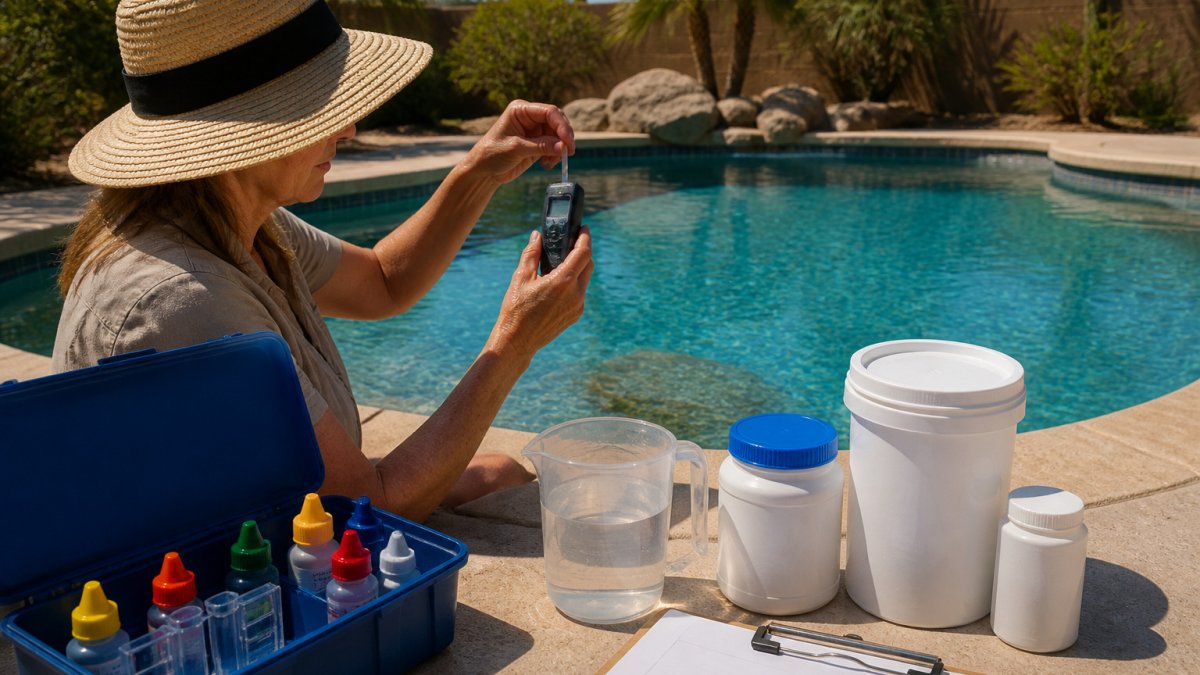
To find your volume, multiply length by width by average depth, then multiply by 7.5 for gallons. Always add chemicals in small steps. It is easier to add more later than to fix an overdose.
Pool pH and Alkalinity Balance in Hot Weather
pH and total alkalinity work together. Alkalinity acts like a buffer that keeps pH from jumping around.
Troubleshooting Cloudy or Green Water After a Heat Wave
Most summer water problems trace back to one of four causes: low free chlorine, high CYA, rising calcium hardness from evaporation, or poor filtration. Work through them in order rather than shocking blindly.
Start with a full test, not a guess
Test free chlorine, combined chlorine, pH, total alkalinity, calcium hardness, and CYA before you add anything. Write the numbers down. The pattern tells you which branch below applies.
Branch 1: Free chlorine is low but CYA is in range (30-50 ppm)
This is simple chlorine demand from heat and sun. Shock to reach your summer target, brush the walls, and run the pump continuously until the water clears and combined chlorine drops below 0.5 ppm. Retest free chlorine twice a day during a heat wave.
Branch 2: Free chlorine is low and CYA is high (above 80 ppm)
The fix is dilution. Partially drain and refill with fresh water to bring CYA down toward 30-50 ppm. Do not add more stabilized chlorine (trichlor tablets or dichlor shock) until CYA is back in range; switch to liquid chlorine or unstabilized shock in the meantime. In peak summer, drain during early morning to reduce evaporation loss and heat stress on the plaster.
Branch 3: Calcium hardness is climbing (above 400 ppm)
Evaporation leaves calcium behind, and refilling with hard fill water adds more. Over a summer, hardness can climb steadily. Signs: white scale at the waterline, cloudy water that will not clear, and rough plaster.
- Confirm with a calcium hardness test and check your fill water hardness once.
- If hardness is high, partial drain and refill with softer water is the reliable fix.
- Keep pH and alkalinity in range; high pH accelerates scaling.
- Use a sequestrant only as a short-term measure, not a substitute for dilution.
Branch 4: Chemistry looks fine but water stays cloudy
When chlorine, pH, alkalinity, calcium, and CYA are all in range, the problem is usually filtration or circulation. Check the filter pressure against its clean baseline; a rise of 8 to 10 psi means it is time to clean or backwash. Look for dead spots where water does not circulate, and run the pump longer during heat waves. A dirty filter and low flow will keep water cloudy no matter how well you balance it.
Green water that will not clear
If algae persists after two proper shock cycles with in-range CYA and a clean filter, the cause is usually one of three things: CYA too high (see Branch 2), filtration too weak for the pool volume, or algae hiding in ladders, light niches, and skimmer throats. If the water has already turned green, green pool recovery and acid wash services can handle tougher algae or staining. Brush every surface, including behind the light and under the ladder, and run the filter around the clock until the water is clear and chlorine holds overnight.
When to call for service
If the water stays green after two rounds of shock and balancing, or if hardness and CYA keep climbing despite your adjustments, the pool may need a partial drain, filter service, or pump inspection. Those are the cases where a professional chemistry check saves time and chemical cost.
Booking a Summer Chemistry Check With Absolute Blue Pool
Absolute Blue Pool offers consistent service days and proactive updates on your pool's health, with no lock-in contracts. To choose the right visit, you can review the chemical-only pool service options.
If your water has already turned green, we also offer recovery services. For current prices and availability, request a quote from our website.
Frequently Asked Questions
How often should I test pool water during extreme heat?
During Arizona summers, test free chlorine, pH and total alkalinity at least every two to three days, and daily during heat waves or after heavy use. High temperatures and direct sun burn off chlorine quickly, so weekly testing is usually too infrequent. Keep a log of results so you can spot trends and adjust before levels drift outside target ranges. Retest about an hour after any chemical addition to confirm the adjustment took effect.
How does hot weather affect pool chlorine levels?
Sunlight breaks down unstabilized chlorine through UV exposure, and water temperatures above 90 degrees Fahrenheit speed up that loss. In Arizona, free chlorine can drop noticeably within a single day during summer. Cyanuric acid, the stabilizer in many pool products, slows this loss, but it must stay within its own target range, because too much stabilizer makes chlorine less effective. Check stabilizer levels monthly during the hot season.
What pool chemical levels should I maintain in summer?
A common target range for free chlorine is 2 to 4 ppm in summer, with pH between 7.4 and 7.6 and total alkalinity between 80 and 120 ppm. Cyanuric acid is typically kept between 30 and 50 ppm, and calcium hardness between 200 and 400 ppm for plaster pools. Use these as starting points and adjust to your pool's surface and equipment recommendations. Consistent readings within range matter more than hitting the exact midpoint.
Does high heat affect pool pH and alkalinity?
Yes. Heat increases evaporation, which concentrates dissolved minerals and can push pH and alkalinity upward over time. Chlorine additions also shift pH, and many chlorine products are acidic or alkaline enough to change the balance. Because alkalinity acts as a buffer, correct total alkalinity first when it is out of range, then adjust pH. Adjusting pH before alkalinity is a common mistake that leads to unstable readings.
