Last Updated: November 22, 2026
Quick Summary
Pool maintenance for rental properties is the shared set of cleaning, chemical, and equipment tasks that keeps a pool safe and swimmable, split between landlord and tenant by the lease. Landlords own equipment repair, structural issues, and safety compliance, while tenants handle light, frequent tasks like skimming, basket cleaning, and water testing. A written checklist and specific lease clause prevent most disputes.
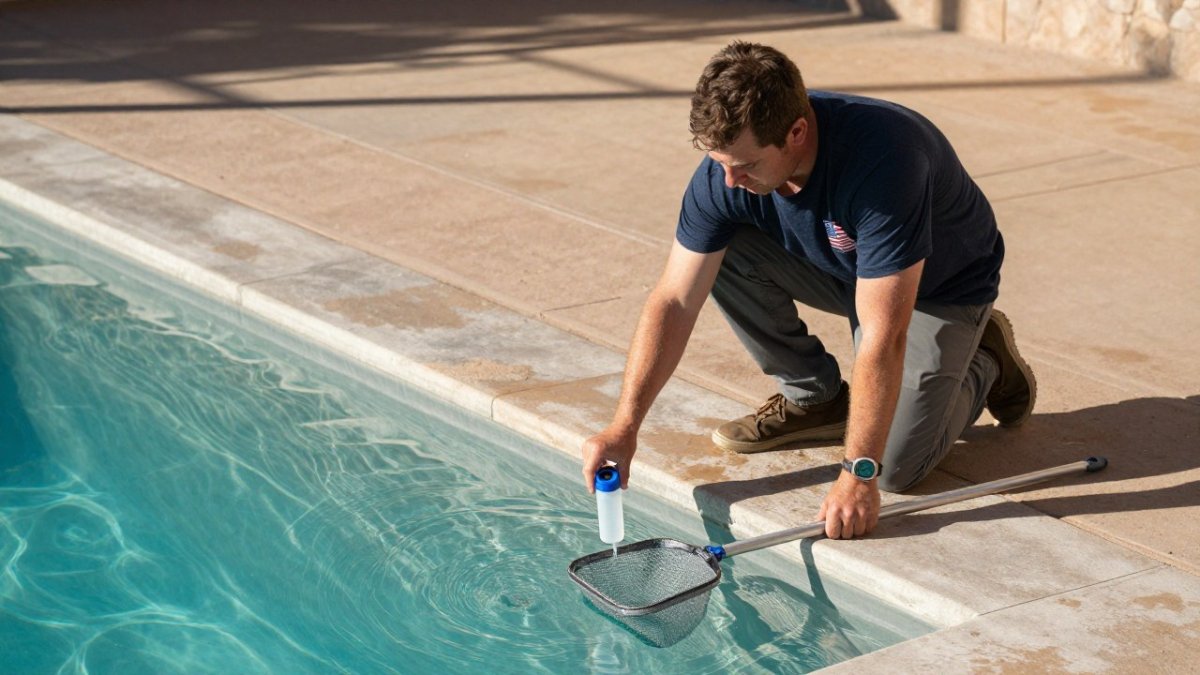
- Tenants should skim the surface three times per week and brush walls and steps weekly.
- Test free chlorine and pH at least twice per week and log all results.
- Clean or backwash the filter when pressure rises 8-10 psi above the clean baseline.
- Tenants must report cloudy water, green tint, or odd noises within 24 hours.
- Photograph and document the pool condition at both move-in and move-out.
Table of Contents
- Who Handles Pool Maintenance for Rental Properties
- Landlord Pool Maintenance Responsibilities
- Tenant Pool Maintenance Responsibilities
- Your Rental Property Pool Maintenance Checklist
- Pool Maintenance Cost for Rental Property: DIY vs. Professional
- Lease Clauses, Move-In Documentation, and Liability
- Booking a Pool Service That Fits Your Rental
- Frequently Asked Questions
Who Handles Pool Maintenance for Rental Properties
Pool maintenance for rental properties is the shared set of cleaning, chemical, and equipment tasks that keeps a pool safe and swimmable, split between landlord and tenant by the lease.
Many leases never name who skims, who tests, or who pays when the pump dies, so both sides may assume the other handles it.
Below, we break down who owns which task, what belongs in writing, and how to price DIY versus hiring a pro.
Why Ambiguity Costs Landlords Money
A vague lease turns a simple job into a fight. Tenants stop skimming because "that's the pool guy's job." The landlord assumes the tenant is handling it. Weeks pass. Algae blooms.
By then, you may need a full green-to-clean recovery instead of a routine visit, which typically costs more than steady weekly service.
Landlord Pool Maintenance Responsibilities
Landlords own the big-ticket items: the structure, the equipment, and the systems that keep water safe.
- Equipment repair and replacement. Pumps, filters, heaters, and salt cells.
- Structural issues. Cracks, leaks, and deck damage.
- Water quality standards. Making sure the pool meets safety and health rules.
A broken pump is not routine upkeep. It is a capital repair, and the landlord should plan for it.
Tenant Pool Maintenance Responsibilities
Tenants handle the light, frequent tasks that keep the pool from falling behind.
- Skim leaves and debris a few times a week
- Empty the skimmer and pump baskets
- Brush the walls and steps
The key word is "report." Tenants should not attempt repairs. A tenant who "fixes" a filter can void a warranty or cause bigger damage.
Your Rental Property Pool Maintenance Checklist
A written rental property pool maintenance checklist ends most confusion. Give one copy to the tenant and keep one for your records. The schedule below suits a typical single-family rental with a plaster finish and a cartridge or sand filter.
Daily Tasks (Five Minutes or Less)
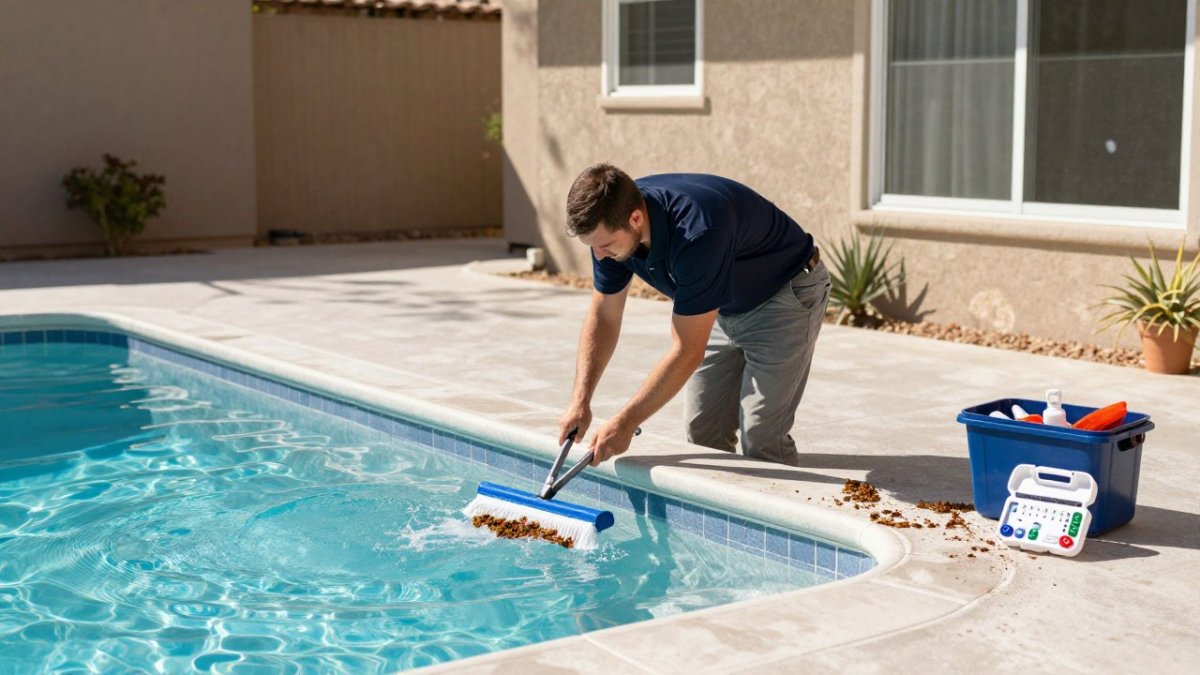
Daily care is about catching problems early, not deep cleaning. A tenant can do these in minutes:
- Skim the surface with a hand net, focusing on the skimmer throat and corners
- Check the skimmer basket and empty it if it is more than half full
- Confirm the water level is at the mid-skimmer mark; add water if it is below the mark
Weekly Tasks and Measurable Thresholds
Vague instructions like "keep it clean" get ignored. Give tenants clear thresholds they can check and record:
- Skim the surface three times per week (daily during heavy leaf drop or storm season)
- Empty skimmer and pump baskets before they are half full
- Brush walls, steps, and the waterline tile once per week
Water-quality targets for a residential pool are set by the test kit manufacturer and local health-code requirements. Follow those instructions for the correct ranges.
When a task has a number attached, it is easy to confirm it happened. The pool log is the proof.
Monthly and Quarterly Tasks
Monthly and quarterly work is where landlords protect the equipment and the surface:
- Inspect the pump basket, O-rings, and lid for wear; lubricate O-rings as directed
- Clean the filter cartridge or backwash the sand or DE filter per manufacturer guidance
- Check the salt cell for scale and clean it if the system calls for it
Seasonal Care: Monsoon Recovery and Summer Chemistry
Desert seasons hit pools hard. For deeper seasonal prep, see our guide on how to prepare a pool for winter.
Season and climate change the schedule. In hot, sunny regions, chlorine demand rises and testing should be more frequent; in cooler months, the pump can run fewer hours and chemical demand drops.
Watch out: Do not let a tenant "shock" a pool without clear instructions and the correct product.
Pool Maintenance Cost for Rental Property: DIY vs. Professional
The real question is not "which is cheaper on paper" but which one actually gets done, week after week. Here is how the two paths compare.
| Factor | DIY (tenant or landlord) | Professional service |
|---|---|---|
| Upfront cost | Low, just chemicals and tools | Monthly flat rate |
| Time required | Several hours per week | None for the owner |
| Consistency | Depends on the tenant | Fixed service day |
| Chemical accuracy | Easy to get wrong | Balanced each visit |
| Equipment care | Often overlooked | Checked every visit |
| Best for | Hands-on tenants | Busy owners and out-of-area landlords |
DIY looks cheaper until a missed week turns into a recovery job. For a realistic monthly picture, read our breakdown of weekly pool service cost per month.
Lease Clauses, Move-In Documentation, and Liability
Most pool disputes are documentation disputes. The lease says one thing, the tenant remembers another, and the pool's condition at move-in was never written down. The fix is a paper trail.
Sample Lease Clause Language
A pool clause should name the task, the frequency, the standard, and the consequence. Vague language like "tenant will maintain the pool" is unenforceable in practice. Use specific, measurable terms. Here is language landlords commonly adapt:
- Tenant duties. "Tenant shall skim the pool surface at least three times per week, empty skimmer and pump baskets before they are half full, brush walls and steps weekly, test water chemistry at least twice per week and log results in the provided log, maintain water at the mid-skimmer mark, and report any equipment malfunction, cloudy water, or unusual noise to Landlord within 24 hours."
- Landlord duties. "Landlord shall maintain the pool structure, pump, filter, heater, and salt cell in working order, perform major chemical corrections when water is significantly out of balance, and ensure fencing, gates, and drain covers meet applicable safety codes."
- Professional service option. "Landlord may engage a licensed pool service to perform weekly cleaning and chemical balancing. Tenant shall provide access on the scheduled service day and shall not perform repairs or add chemicals other than as directed."
Watch out: Some states and municipalities impose specific pool-safety requirements (for example, fencing, gate alarms, drain-cover standards, or disclosure obligations) that override lease language. Confirm the rules that apply where the property is located before finalizing any clause.
Move-In and Move-Out Pool Condition Checklist
Photograph and document the pool at both ends of the tenancy. A dated checklist signed by both parties is stronger than memory. Record:
- Water clarity and color, with a photo of the pool floor drain visible
- Water test results (free chlorine, pH, total alkalinity, cyanuric acid, calcium hardness) with the test kit or strip brand noted
- Pump, filter, heater, and salt cell make, model, and serial number, with photos
- Skimmer and pump basket condition
At move-out, repeat the same checklist. Compare side by side. If the water is green or equipment is damaged, the documentation supports a deduction or repair claim.
Emergency Response and Liability
A pool emergency is not the time to improvise. Give tenants a one-page emergency card with these steps:
- Chemical incident. If a chemical is spilled or mixed incorrectly, evacuate the pool area, do not add water to the chemical, ventilate if indoors, and call the local fire department or poison control if anyone is exposed. Do not attempt to neutralize chemicals without professional guidance.
- Equipment failure. If the pump stops, the filter leaks, or the heater fails, turn off the equipment at the breaker, do not attempt repair, and notify the landlord immediately. Continued operation can cause damage or unsafe water.
- Unsafe water. If water is cloudy, green, or has visible algae, keep swimmers out until chemistry is corrected and the water clears. Cloudy water can mask a swimmer in distress.
- Pool-related injury. Call 911 for any serious injury, do not move a person with a suspected spinal injury, and document the incident with photos and witness statements as soon as it is safe to do so.
Liability protection is mostly records: the signed lease clause, the move-in checklist, the water-test log, service invoices, and incident reports. Keep them together. If a dispute or claim arises, that file is your defense.
Responsibility Matrix by Lease Type
Responsibility shifts with the lease structure. A quick matrix helps landlords and tenants see the split at a glance:
| Task | Full-service lease (landlord retains pool care) | Tenant-maintained lease | Professional service addendum |
|---|---|---|---|
| Skimming and debris removal | Landlord or pro | Tenant | Pro |
| Water testing and chemical balancing | Landlord or pro | Tenant | Pro |
| Basket cleaning | Landlord or pro | Tenant | Pro |
| Water level | Landlord or pro | Tenant | Pro |
| Equipment repair and replacement | Landlord | Landlord | Landlord |
| Structural repair | Landlord | Landlord | Landlord |
| Safety compliance | Landlord | Landlord | Landlord |
| Reporting problems | Tenant | Tenant | Tenant |
| Major chemical correction | Landlord | Landlord | Landlord or pro |
Use the matrix as a lease exhibit. When both parties sign it, the split is clear before the first dispute.
Booking a Pool Service That Fits Your Rental
The best service is the one that shows up on the same day every week and tells you what it found.
Before you sign, ask for an itemized quote. Our guide on avoiding hidden fees in pool cleaning shows which charges to watch for. Then request a custom pool care quote so you know the real monthly number.
At Absolute Blue Pool, we have served Valley owners since 2004 with flat-rate pricing and no lock-in contracts. You can also see our full-service pool cleaning offering to compare what is covered.
Stop guessing whether the pool is ready for your next tenant. Get started with Absolute Blue Pool and keep your rental's water clear, safe, and stress-free all year.
Frequently Asked Questions
Who is responsible for pool maintenance: the landlord or the tenant?
It depends on what the lease says, but the safest structure puts structural and equipment care on the landlord and routine surface tasks on the tenant. Landlords typically cover the pump, filter, heater, resurfacing, and any repair tied to normal wear. Tenants usually handle skimming, emptying baskets, and reporting problems promptly. When the lease is silent, disputes get expensive, so name every task and who pays for it before move-in. Many landlords simply build weekly professional pool maintenance into rent and remove the question entirely.
How often should a rental property pool be cleaned and serviced?
Weekly service is the standard for a rental property pool in a hot climate. Between professional visits, tenants should skim debris and empty the skimmer baskets every few days, and after a monsoon storm they should check the water and remove leaves immediately. Water chemistry should be tested at least twice a week in summer, since heat and heavy use burn through chlorine faster. A written rental property pool maintenance checklist with these intervals prevents the green-pool calls that cost far more than routine service.
What is the typical pool maintenance cost for a rental property?
Costs split into routine service, chemicals, and repairs. A recurring weekly service plan is usually a flat monthly rate based on pool size and condition, while chemicals may be bundled or billed separately depending on the provider. Repairs like pump or filter replacement are separate line items and should be budgeted as reserves. Because pricing varies by pool size, condition, and schedule, request a written quote from the provider and confirm whether chemicals are included.
Can a landlord rent out a property with a pool and still limit liability?
Yes, but the work happens before the tenant moves in. Confirm the pool meets local barrier and safety requirements, document the pool's condition with dated photos and a water test at move-in, and put maintenance duties in writing inside the lease. Require tenants to report hazards and equipment problems immediately, and keep records of every service visit. Liability rarely comes from having a pool; it comes from unclear duties and no paper trail showing the pool was maintained.
